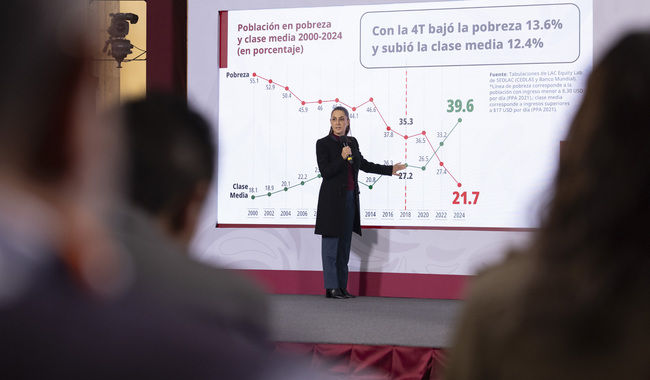

President Claudia Sheinbaum Pardo highlighted that Mexico is the Latin American country with the highest middle-class growth, with an increase of 12.4 percent between 2018 and 2024, according to World Bank data. The share of the population in the middle class rose from 27.2% to 39.6%, a result attributed to the social programs promoted by the Fourth Transformation.
During her morning press conference, “Las Mañaneras del Pueblo,” Sheinbaum stated that this achievement stems from a public policy rooted in Moral Economy, guided by humanist and rights-based principles. “These are not welfare programs; these are rights,” she emphasized, referring to the Programas para el Bienestar, which are expected to reach a social investment of one trillion pesos by 2026.
The president recalled that one of the most significant accomplishments of the previous administration was lifting 13.5 million people out of poverty between 2018 and 2024, during the presidency of Andrés Manuel López Obrador. This structural change, she said, reflects a new development model that prioritizes the poorest without excluding the rest of society.
Sheinbaum also underlined the impact of the increase in the minimum wage, which will rise to 315.04 pesos per day nationwide and 440.87 pesos in the Northern Border Free Zone in 2026. These adjustments are boosting household income and helping more people enter the middle class.
Meanwhile, Jesús Ramírez Cuevas, Chief Advisor to the Presidency, explained that this wage increase is part of a broader policy that benefits all social sectors, not just the most vulnerable. Welfare Secretary Ariadna Montiel Reyes added that the country’s transformation is grounded in the recognition of universal rights, with no intermediaries or conditions.