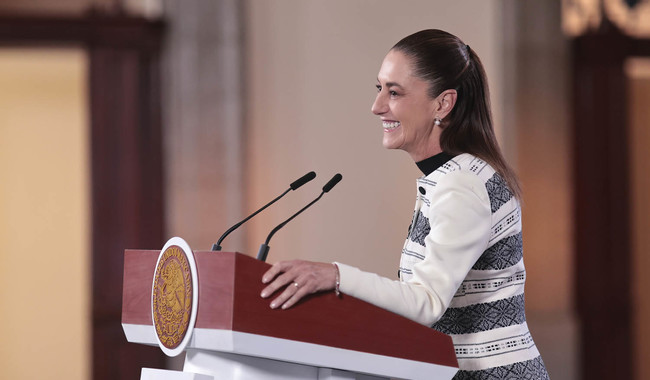

President of Mexico Claudia Sheinbaum Pardo presented the Infrastructure Investment Plan for Development with Wellbeing 2026–2030, which includes a combined public and mixed investment of 5.6 trillion pesos across eight strategic sectors: energy, railways, highways, ports, health, water, education, and airports. For 2026 alone, an additional 722 billion pesos will be allocated—equivalent to 2% of the Gross Domestic Product (GDP).
During her morning press conference “Las mañaneras del pueblo”, Sheinbaum emphasized that this investment model breaks away from the public-private partnerships of the neoliberal era. She stressed that no burdensome debts will be incurred and no concessions granted, as the State will retain control over strategic projects, prioritizing sustainable development, wellbeing, and social justice.
The strategy, designed by the Ministry of Finance and Public Credit, is based on four key pillars: the Strategic Investment Planning Council, New Investment Vehicles, Regulatory Updates, and a National Database. These components will ensure proper tracking, transparency, and technical long-term planning of new projects.
Finance Minister Édgar Amador Zamora explained that the plan was built on a technical and financial analysis of more than 1,500 projects. Banobras Director General Jorge Mendoza Sánchez added that mixed investments enable the State to maintain leadership, expedite strategic works, and protect public finances—as seen in past projects such as the Iberdrola plants, Tepic Airport, and the Las Varas-Compostela highway.
Deputy Secretary María del Carmen Bonilla Rodríguez highlighted the multiple benefits of the plan, from boosting sustainable and regional economic growth to maintaining sound public finances and improving connectivity across states and municipalities. With this strategy, the Mexican government consolidates a model of shared prosperity based on responsible investment, social equity, and a forward-looking vision.