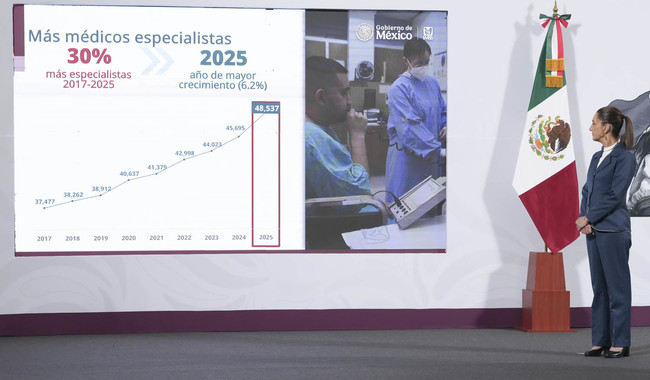

Mexican President Claudia Sheinbaum Pardo announced that 2025 marked a historic record in the training and hiring of medical specialists by the Mexican Social Security Institute (IMSS), significantly improving healthcare services nationwide. IMSS now has 48,537 specialists—representing a 30% increase compared to 2017.
During her Las Mañaneras del Pueblo press conference, the president noted that this progress is part of a policy initiated by former President Andrés Manuel López Obrador to expand access to medical specialties. Sheinbaum emphasized that training more professionals will strengthen consultations, diagnostics, and specialized services within the public healthcare system.
IMSS Director General Zoé Robledo Aburto reported that the 2025 selection process, known as the “Draft,” recruited 9,615 new medical specialists—twice as many as in 2018. Under the 3-20-100 strategy, 30 million specialty consultations are projected for this year, four million more than in 2024. To achieve this, clinics will extend service hours, implement evening and weekend shifts, and introduce express routes for critical patients and new hospital referral systems.
As part of the Health House to House program, Sheinbaum also announced the rollout of 15,000 Well-being Pharmacies starting in August. Of these, 5,000 will be located in remote Well-being Stores, while 10,000 will be placed outside IMSS, ISSSTE, and IMSS Bienestar Health Centers. Medications—especially for chronic conditions—will be distributed free of charge to elderly and disabled individuals, supported by BIRMEX and the Well-being Nutrition Program.
In another major announcement, the president remotely inaugurated the Urban Health Center of Jerez in Zacatecas, operated by IMSS Bienestar, which will serve over 36,000 people. Meanwhile, ISSSTE Director Martí Batres Guadarrama confirmed the construction of the High Specialty Regional Hospital in Oaxaca. With a 3 billion peso investment, the facility will include 250 beds and 43 outpatient offices, benefiting more than 1.5 million people in Oaxaca, Puebla, Veracruz, and Chiapas.