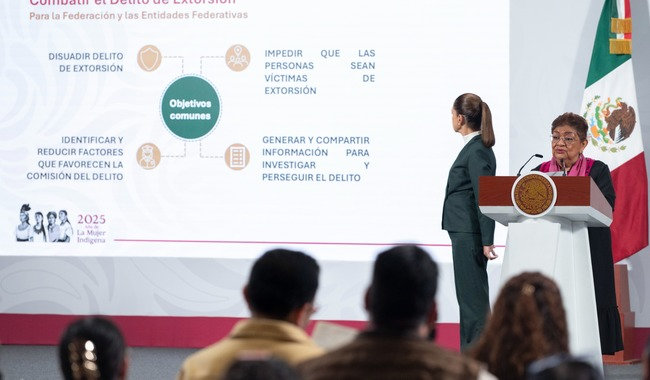

President Claudia Sheinbaum Pardo has sent a national anti-extortion bill to the Congress of the Union, as part of a comprehensive strategy to prevent, investigate, and punish this crime, which severely impacts Mexican society.
Ernestina Godoy Ramos, Legal Counsel to the Federal Executive, explained that the initiative is based on the recent amendment to Article 73 of the Constitution, published on October 9 in the Diario Oficial de la Federación. This reform grants Congress the authority to issue a General Law Against Extortion, enforceable across the country.
The draft law was developed through a technical working group comprised of various federal institutions. It proposes a basic criminal classification, outlines inter-institutional coordination guidelines, and introduces specific provisions to combat extortion from within prisons. It also includes joint prevention programs.
Key provisions of the initiative include prison sentences ranging from six to fifteen years, with aggravated penalties for “cobro de piso” (protection rackets), offenses involving migrants or minors, or perpetration by public officials. The strategy to prevent and combat extortion, including the anonymous reporting line 089, would be codified in law.
Additionally, the proposal includes reforms to multiple legal frameworks:
- Federal Criminal Code
- Law Against Organized Crime
- National Code of Criminal Procedure
- National Asset Forfeiture Law
These changes would allow extortion to be treated as a crime subject to asset forfeiture.
President Sheinbaum emphasized that this initiative seeks to strengthen coordinated government action to eradicate extortion, ensuring greater legal certainty and more effective criminal justice mechanisms throughout the country.