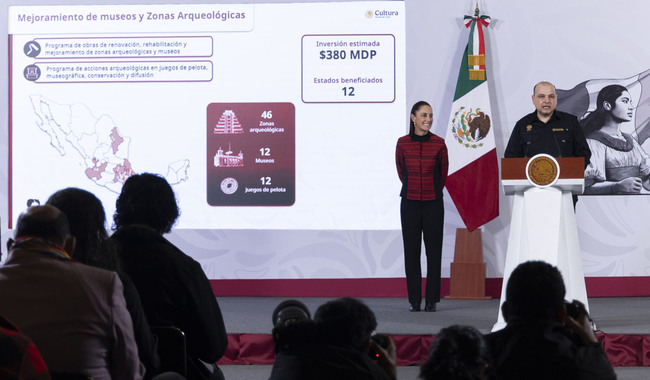

President of Mexico Claudia Sheinbaum Pardo highlighted progress in the rehabilitation of 1,405 spaces in the schools of the National Institute of Fine Arts and Literature (INBAL) and 220 spaces of the National Institute of Anthropology and History (INAH), as well as a 380 million peso investment to improve 12 museums and 46 archaeological sites across 12 states in the country.
In this context, the president announced the inauguration, scheduled for late May, of the first Textile Museum of Indigenous and Afro-Mexican Peoples, to be located in the Casa del Marqués del Apartado in Mexico City. The museum will feature three exhibition floors and 210 permanent exhibition pieces, aiming to preserve and promote Mexican textile art, considered unique in the world.
Culture Secretary Claudia Curiel de Icaza detailed that INBAL schools will receive upgrades in 118 dance classrooms, 265 music rooms, 384 academic and administrative classrooms, waterproofing in 49 schools, six galleries, acquisition of 23,000 musical instruments, as well as furniture and scientific equipment for laboratories and workshops. Meanwhile, INAH spaces underwent intervention in 122 classrooms, 13 laboratories, and one specialized storage facility, along with curriculum updates and increased enrollment capacity.
INAH Director General Joel Omar Vázquez Herrera stated that the 380 million pesos invested in museums and archaeological sites cover renovation, rehabilitation, and conservation actions, with 46% progress achieved in the 12 beneficiary states, which include 46 archaeological sites, 12 museums, and 12 ball courts. These efforts aim to improve the visitor experience.
Deputy Secretary of Cultural Development Marina Núñez Bespalova noted that the Textile Museum will also offer a café and restaurant, a recreational space, a temporary exhibition hall, a training room, a multipurpose hall, an interactive room, and a storage facility. The project seeks to showcase the artisanal work of Indigenous and Afro-Mexican peoples, integrating their craftsmanship and creativity into the country’s cultural heritage.