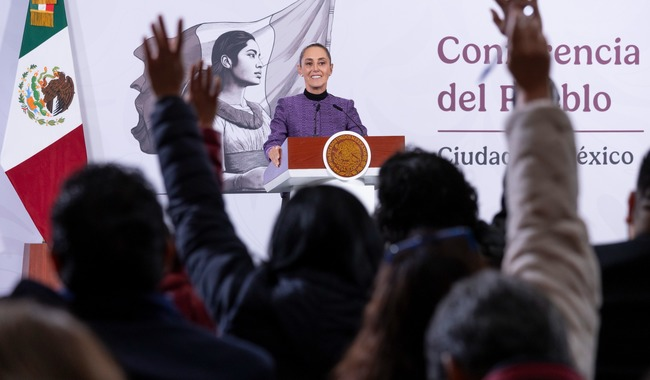

Mexican President Claudia Sheinbaum Pardo announced that from March 2 to December 31, 2026, the government will carry out the credentialing process for the Universal Health Service, aiming to ensure that all Mexican citizens possess an identification card that guarantees their right to medical care at public health institutions nationwide.
The president explained that the new ID will grant access to services provided by the Mexican Social Security Institute (IMSS), the Institute for Social Security and Services for State Workers (ISSSTE), IMSS Bienestar, the health services of the Armed Forces, and the National Institutes of Health. The card will also facilitate integration and access to electronic medical records via a QR code, with protected personal data.
Sheinbaum detailed that the credentialing process will involve an investment of 3.5 billion pesos, allocated to the installation of 2,365 modules and 9,791 data collection stations, along with the printing of ID cards, as part of the national strategy to digitize and strengthen the public health system.
Federal authorities noted that registration will take place Monday through Saturday, from 9:00 a.m. to 5:00 p.m. Minors must present a birth certificate with CURP, proof of address, and a valid ID from a parent or legal guardian. Adults must provide an official photo ID, CURP, and proof of address.
The credentialing campaign will begin on March 2 in the states of Baja California Sur, Campeche, Hidalgo, State of Mexico, Michoacán, Nayarit, Puebla, San Luis Potosí, Sinaloa, Sonora, Tabasco, Tamaulipas, Tlaxcala, Yucatán, and Zacatecas. On March 23, the process will expand to Baja California, Chiapas, Mexico City, Colima, Guerrero, Morelos, Oaxaca, Quintana Roo, and Veracruz. The registration schedule will be organized based on the first letter of individuals’ last names.