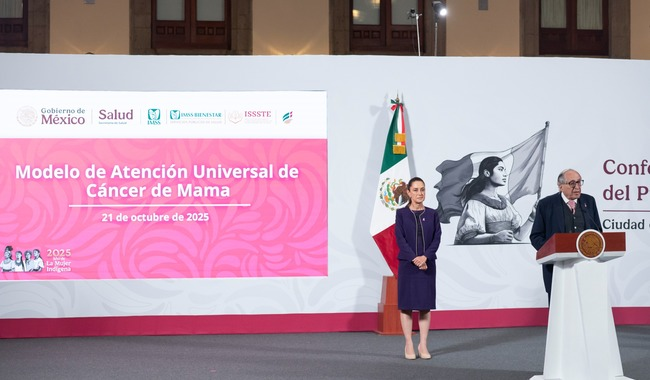

President of Mexico, Claudia Sheinbaum Pardo, has announced a historic investment of 8 billion pesos to implement a Universal Breast Cancer Care Model aimed at revolutionizing the national response to breast cancer—the leading cause of death among women in the country. This initiative guarantees comprehensive care, covering prevention, early detection, and timely treatment for all Mexican women.
During her morning press conference known as “Las Mañaneras del Pueblo,” Sheinbaum detailed that between 2026 and 2027 the government will acquire 1,000 mammography machines and 1,000 ultrasound systems, along with supplies and reagents, adding to the 656 machines already in use. The plan also includes the construction of 20 Diagnostic Centers with specialized imaging and pathology personnel, as well as 32 Oncology Care Units—one in each state.
She emphasized that the program marks a turning point in Mexico’s healthcare system and reflects her administration’s firm commitment to women’s health. Resources will be distributed equitably among the Mexican Social Security Institute (IMSS), IMSS Bienestar, and ISSSTE, ensuring that services are accessible to the entire population regardless of social security affiliation.
Health Secretary David Kershenobich Stalnikowitz explained that the model is based on five pillars: promotion, prevention, early detection, diagnosis, and treatment. With the newly planned equipment, the system will be capable of performing 8.9 million mammograms annually. The goal is to reduce the time between initial suspicion and diagnosis to no more than 30 days, and between diagnosis and treatment to just 21 days—drastically lowering breast cancer mortality.
Alejandro Svarch Pérez, head of IMSS Bienestar, announced that the “La Pastora” Women’s Oncology Hospital, set to open this December in Mexico City, will be the country’s first fully integrated, free, and universal cancer center. With an investment exceeding 300 million pesos, the facility will be outfitted with cutting-edge technology and have the capacity to treat more than 12,000 women annually.