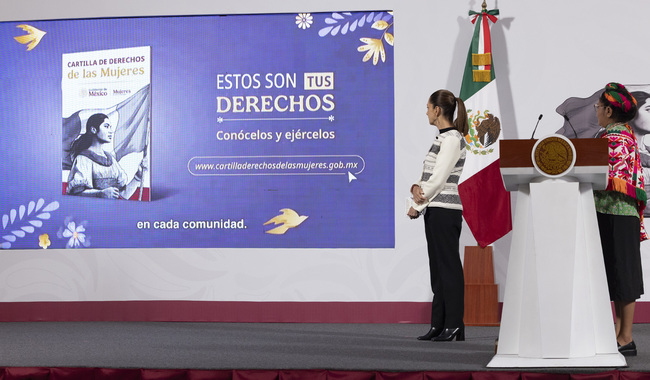

On the occasion of the International Day of Indigenous Women, the Government of Mexico announced that the Women’s Rights Booklet has been translated into 35 indigenous languages, a historic effort aimed at ensuring its dissemination across the country and promoting the full exercise of rights for women, adolescents, and girls from Indigenous peoples.
President Claudia Sheinbaum Pardo emphasized that this initiative represents a recognition of Indigenous women who for decades were rendered invisible due to racism. “We want to vindicate them because they are the essence of Mexico, those who transmit culture and languages. We recognize their work for their families and reaffirm that all women have the same rights,” she said during her morning press conference.
According to the Ministry of Women, led by Citlalli Hernández Mora, and the Undersecretary for Substantive Equality, María Elvira Concheiro Bórquez, the booklet will be distributed to 6,700 schools with the support of 17,000 teachers, reaching nearly 400,000 students. In addition, audiovisual versions already exist in 27 languages, and translation into 27 more is underway across 18 states.
María de los Ángeles Gordillo Castañeda, Director of Intercultural and Bilingual Indigenous Education at the Ministry of Public Education (SEP), reported that this project involves communities from Baja California, Campeche, Chiapas, Guerrero, Oaxaca, Puebla, Veracruz, among other states. Specialists from the National Institute of Indigenous Languages stressed that this initiative strengthens both women’s rights and linguistic rights in Mexico.
Representatives from Conapred and Indigenous translators stated that the booklet symbolizes genuine inclusion by bringing awareness of rights directly to communities. Mazahua interpreter Ana Elvia Paulino Escamilla and a Teenek interpreter agreed that this material will allow more women and girls to be certain that they can choose their own paths, strengthening autonomy and social participation.