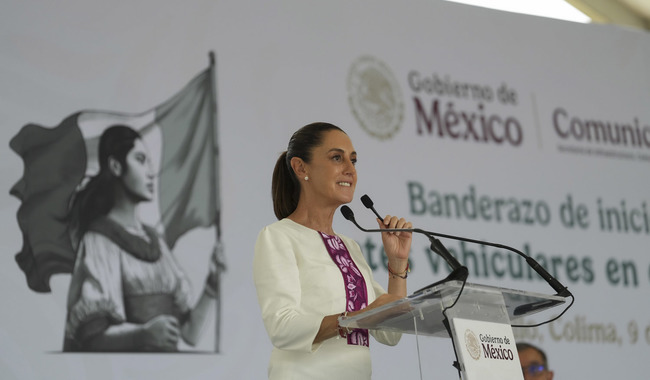

President Claudia Sheinbaum Pardo kicked off the construction of the Tepalcates II, Presa Trancas, and El Chical bridges, works that are part of a comprehensive strategy to modernize Colima’s road and port infrastructure. These projects, along with the Libramiento Arco Norte and Arco Sur bridges already underway and those scheduled for 2026 (Las Tunas, Barrio V, Main Entrance to Manzanillo, and La Flechita), represent a combined investment of nearly 2 billion pesos and a total length of 4 kilometers.
The federal president announced that, between 2025 and 2026, Colima will receive almost 4 billion pesos in investments aimed at development and well-being. She emphasized that one of the top priorities is the expansion of the Port of Manzanillo, currently the third most important in Latin America, with the goal of making it the first. “Manzanillo is already the third port in Latin America, but we are going to make it the first,” she stated.
Sheinbaum stressed that the port expansion will be carried out with both public and private investment, under the coordination of the Secretariat of the Navy, and that the conservation of the Cuyutlán Lagoon will be ensured to minimize environmental impact. She assured that port development will be accompanied by actions that benefit the entire state, especially the Manzanillo metropolitan area.
The Secretary of Infrastructure, Communications, and Transport, Jesús Esteva Medina, explained that the Tepalcates II Bridge, with an investment of 750 million pesos, is part of the Armería–Manzanillo Highway; while the Presa Trancas and El Chical bridges correspond to reconstruction efforts following the damage caused by Hurricane Lidia. In total, the construction of these works will generate 12,000 direct and indirect jobs.
The governor of Colima, Indira Vizcaíno Silva, pointed out that 20 billion pesos are being allocated to the entire state highway corridor and that the Tepalcates II Bridge has been designed with environmental conservation criteria, ensuring that it will not affect the Cuyutlán Lagoon’s body of water.