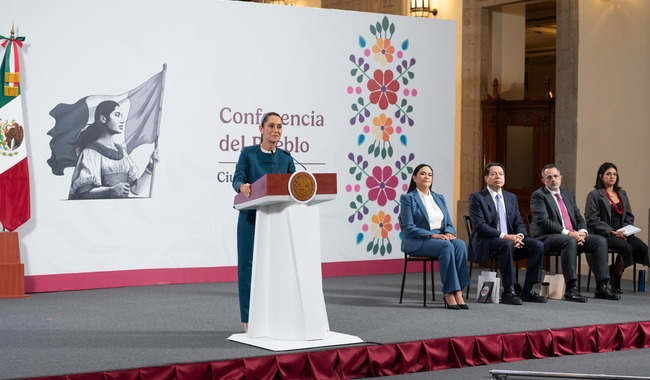

Mexican President Claudia Sheinbaum Pardo has announced a sweeping reform of the country’s upper secondary education system, which will take effect in September as part of the New Mexican School initiative. The new National High School System (SNB) aims to expand educational coverage, strengthen technical training, and create new opportunities for young people to stay in school.
Speaking during the “People’s Morning Conference,” Sheinbaum emphasized that this strategy is designed to keep youth engaged in education and away from high-risk environments. “We want young people to stay in school, to enjoy school, instead of being out on the streets at 15,” she stated.
The new SNB will unify the 32 existing subsystems of upper secondary education and offer students a dual certification: the General Baccalaureate, which grants access to higher education, and the Technological Baccalaureate, which includes a technical certificate endorsed by public institutions. Enrollment will increase by 37,500 new seats through the construction of 20 new preparatory schools, the expansion of 33, and the conversion of 35 secondary schools.
Mario Delgado Carrillo, Secretary of Public Education, explained that 150 infrastructure projects are already underway as part of this effort. Deputy Secretary Tania Rodríguez Mora added that, for the first time, there will be a unified national curriculum with core subjects such as Language and Communication, Digital Culture, and English, along with a labor framework that includes basic job skills and technical certifications.
In line with Plan México and regional Development Poles, the SNB will introduce new career tracks in strategic sectors such as Cybersecurity, Robotics, Electromobility, Artificial Intelligence, and Semiconductors. By next year, the academic offerings will also include E-commerce, Urban Planning, and Nanotechnology, among other disciplines tailored to meet national demands and prepare youth for a competitive future.